
How to provide proper protection from ESD in small jobs?
Is there a simple protection against uncontrolled electrostatic discharge? Before answering this question, it is necessary to consider what this phenomenon is and why it arises. In this article, we will present basic information on protection against electrostatic discharge and what are the risks associated with it and ways to protect against it.
Electrostatic discharge (or ESD for short) is a phenomenon resulting from the rapid movement of electrons between bodies of different potential. Imagine the structure of an atom. The nucleus of the atom contains protons and neutrons, with electrons orbiting around the nucleus. Electrons have the ability to move, so if one material tends to accumulate electrons - it will be negatively charged. In contrast, the other material, which will tend to lose electrons, will be positively charged. As the materials approach each other, there can be an equalization of potential between them, that is, a sudden jump of electrons, and this is what is called an electrostatic discharge. Having got the theory behind us, we can now focus on protection against this phenomenon.
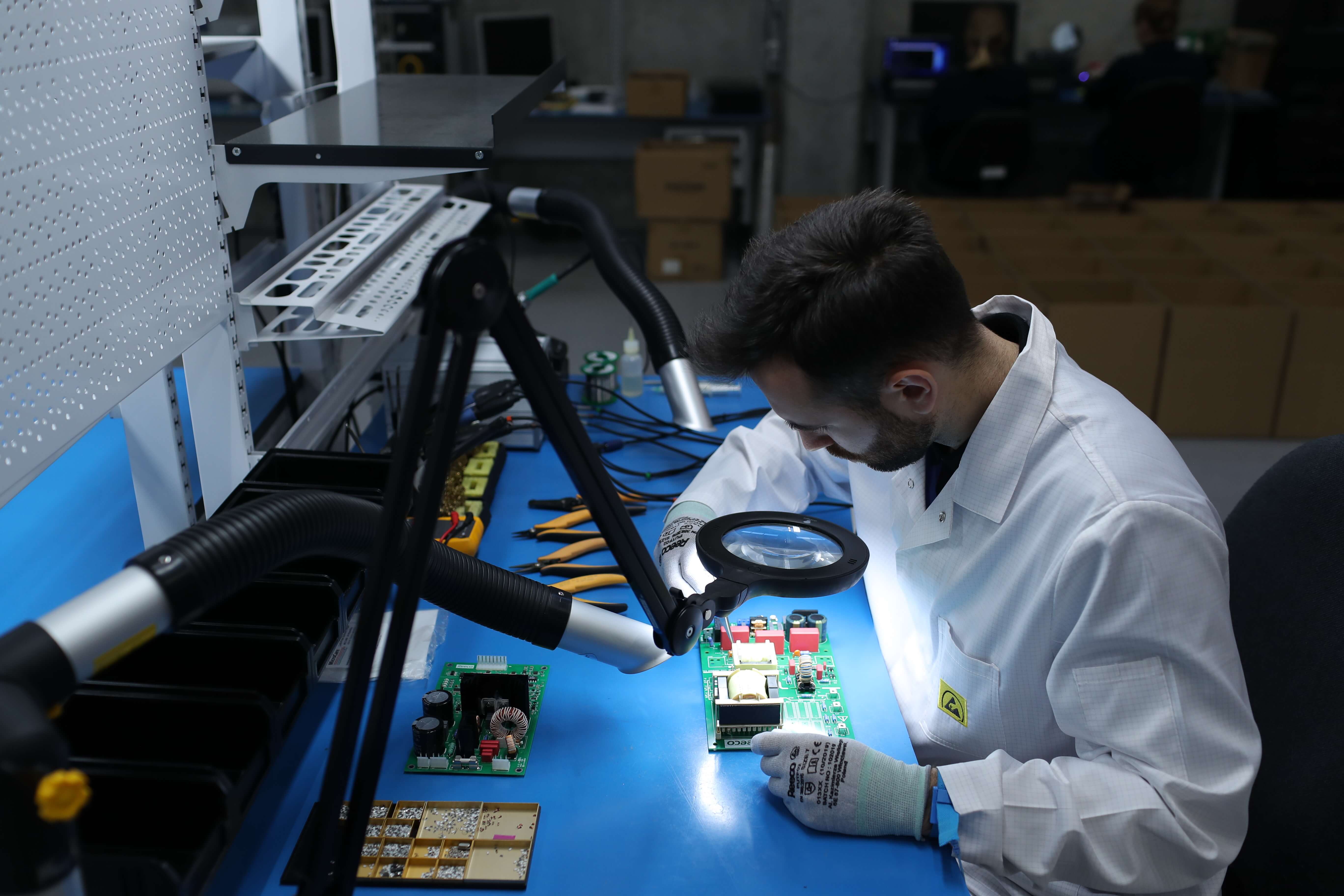
Protection against ESD - person and clothing
One of the basic protections against electrostatic discharge is the use of a wrist band. This wristband should have a conductive inner part and a dissipative outer part, and it should be connected with a wire with a 1MΩ resistor to a marked grounding point to which the workstation equipment is connected. At such a point, there is also protection of 1MΩ resistor per socket. Such sockets can have different forms, they can be mounted under the table top or equally commonly used in the form of a schuko plug, usually found in yellow. Going back to the wristband, according to tests and studies, it is the most reliable ESD protection for seated work, so it is worth keeping it in mind.
Another protection for a person working with electronics, is a special anti-static apron. The purpose of wearing such protection is primarily to protect electronics from the clothing we are wearing, which can generate static charges. The apron will not ground us, but it will create something like a Faraday cage, which will not allow charges to escape to the outside. According to the relevant standards, such an apron must be properly labeled and have certification relevant to its use in areas where one works with electronics sensitive to electrostatic discharge. Moving on to the next item of clothing of a person working with ESD-sensitive electronics, we should include footwear or special shoestraps. It is usually recommended to wear grounded footwear, as it generally keeps its charge-conducting properties better. Besides, they are more comfortable to work with and safer. A cheaper alternative is to use shoestraps. However, it should be kept in mind that they are not as durable as footwear and often require proper instructions for putting them on, as the people do not always know how to do it properly. In footwear as in the shoestrap, there is also a resistor protection. In the case of shoes with a value of 2MΩ. We must remember that shoestraps, just like shoes, are to be worn in pairs, not individually! In the whole system of human-footwear-floor grounding, you need to know that it all works with each other only if you have the right floor and footwear. This solution will be helpful for standing or mobile work. On the other hand, for seated work, we wear a wrist band anyway, despite the footwear. If we are dealing with electronics that are miniaturized and the sensitivity to electrostatic discharge is much greater, additional anti-static gloves should be used. Such gloves will also have the appropriate static dissipating material in them, as well as a designation that they are safe and can be used in handling ESD-sensitive electronics. An additional positive feature of using such protection is that no dirt is left on the PCB being assembled or serviced.
The last, less commonly used protection is headgear. Probably everyone reading this article will ask themselves: why headgear? Imagine dealing with electronics. A human hair falls on the IC and its leads, the PCB is assembled into the target product and used in a normal working environment. After some time, the moisture in the working environment that surrounds us can be between 35 and 70%, penetrates such a product, and this hair acquiring moisture becomes a conductor that can lead to short circuits.
In summary, the proper protection in jobs where we have to deal with ESD-sensitive electronics is very important, as we are the ones who very often carry electrons and transfer them by equalizing the potential. In addition, we must be aware that a person feels ESD at a level of about 2000V, and we can damage some circuits already with a much smaller electrostatic discharge, so such protection is important.
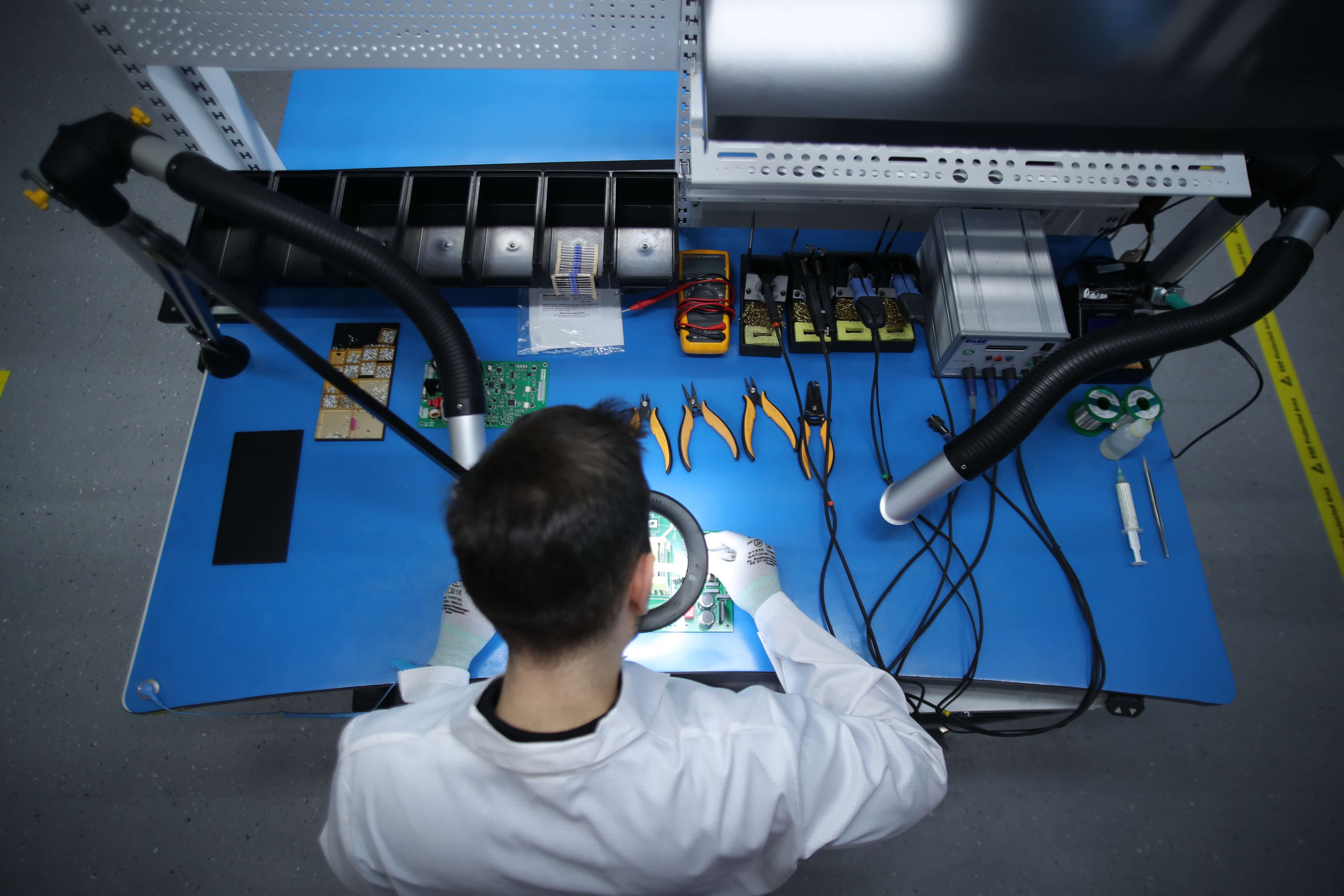
ESD protection - workplace safety measures
In the work area, we should create a specially designated zone where we will work with electronics sensitive to electrostatic discharge. Such a place is called an EPA (ESD Protected Area). The primary protection of our work area is an anti-static mat connected to ground. Such a mat is made of two layers - the lower one is conductive, and the upper one is dissipative. The mat has an additional feature: it is heat-resistant, so can protect our work surface from some thermal damage. We connect the mat to the ground with a wire incorporating a 1MΩ resistor, and here we also suggest using a schuko socket, which we connect to an electrical strip or outlet. In this way, we will use the electrical ground that is in the building. Another piece of equipment is a chair, which should be dedicated to the EPA area. Why? The chair does not ground a person, but it is intended be be anti-static. The idea is that when we move an ordinary chair away from the workstation, a large electrostatic field can be generated, which can in turn cause an uncontrolled electrostatic discharge. What is necessary for the proper operation of such a chair? We must have a floor that will ground this chair. The floor will have a dissipative property, and the chair, thanks to its design, with the help of conductive wheels, will discharge the accumulated charges to ground. The floor and its entire system must be connected to ground. What should be kept in mind when it comes to the rest of the workplace equipment? Anything that can generate charges or cause ESD hazards must be removed from the work surface. What might be included in such unwanted equipment? For example, hand tools that are not dedicated to the EPA zone, static-generating packaging and similar materials that are unnecessary for our work with electrostatic discharge-sensitive electronics.
That's it in a nutshell about the workplace, while the professional EPA zone itself, should consist of a more extensive ESD protection system. What do we mean? That in such a room before the very entrance, we should have, among other things, an appropriate testing system.

ESD hazards
Everyone may ask themselves why all this? Why such safeguards. After all, every young person with an interest in computer science or electronics, or with manual skills, has replaced memory in his or her computer or upgraded the motherboard with additional accessories. They did this on the carpet at home and without any grounding, without taking special care, and everything later worked without problems. It is actions like this that cause us to question whether ESD protection makes sense. We'll say briefly, it does. Why? Because there is no comparison between manufacturing or repairing the electronics and having fun expanding the computer at home. If such ESD damage is detected in the factories, it has no greater financial consequences than that the product is discarded or goes into repair. On the other hand, when the damage comes to light after the customer has already received it, it will have its consequences in the form of dissatisfied customers. And it's important to remember that one dissatisfied customer is a potential ten who won't buy something from us or use our services. The list of ESD threats is endless. Many companies, which are the world's largest electronics manufacturers, follow the principles of ESD protection and do it at a very advanced level. This is due to the studies conducted, the results of which indicated such damage and, unfortunately, had large consequences in the form of huge financial losses. In 20 years, electronics have become highly miniaturized, which in turn has had an impact on sensitivity in the subject of electrostatic discharge. The smaller the electronics, the greater their sensitivity to ESD. Then there are the extensive LED and O-LED technologies, which simply don't like discharges. Then there is the level of ESD protection in the design of such PCB. The best solution will be a top-down assumption that the PCB is sensitive to electrostatic discharge.
In summary, what we have written about electrostatic discharge is only a basic brief explanation of what ESD protection is all about. More information can be obtained from appropriate training courses dedicated to operators or ESD Coordinators.