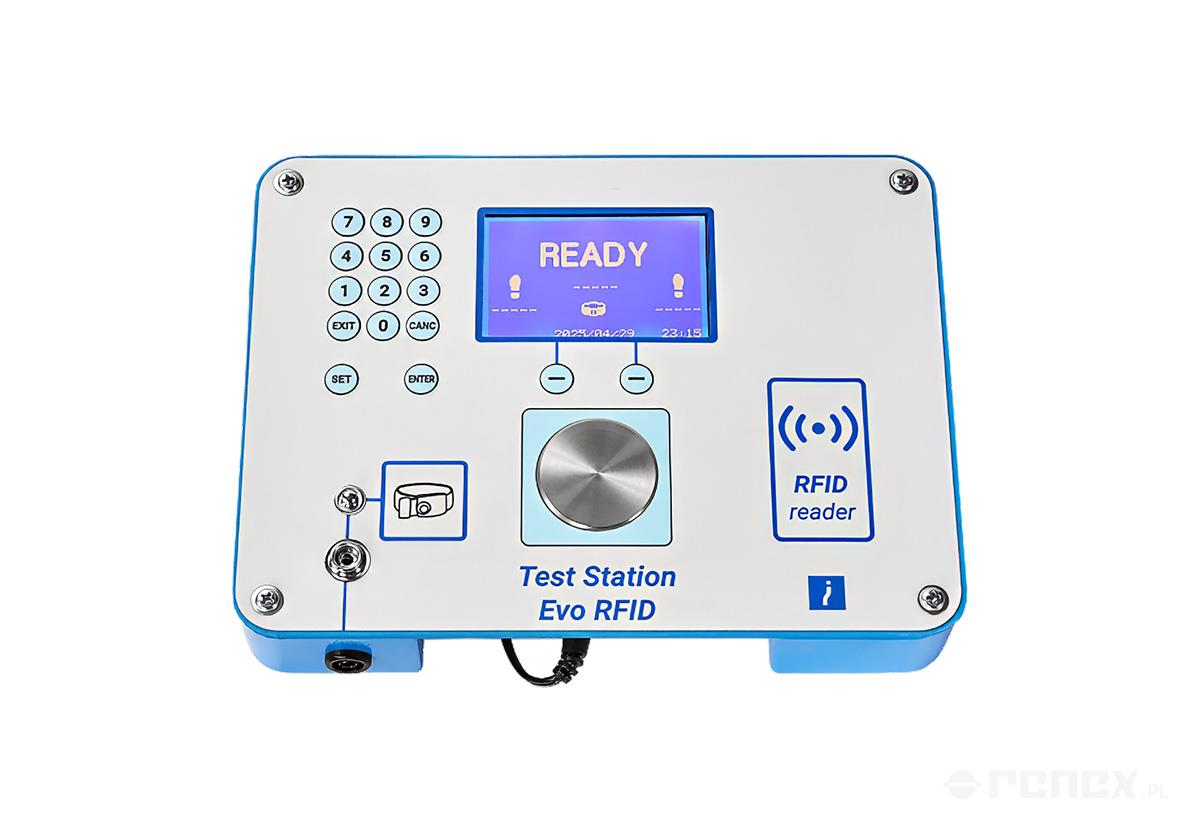
Test Station EVO 9264.929 - test workstation with 125 kHz RFID identification
The Test Station EVO 9264.929 - test workstation with 125 kHz RFID identification has been designed as part of an EPA access control system, enabling fast testing of wrist straps and ESD footwear with simultaneous operator identification. The use of 125 kHz RFID technology allows test results to be assigned to a specific user, increasing procedural transparency and enabling full data archiving.
The device supports up to 200 users and stores up to 10,000 measurement records. Thanks to the LAN RJ45 interface, integration with higher-level systems and further data analysis is possible. The tester is equipped with a graphic LCD with a resolution of 160 × 104 px, ensuring clear presentation of messages and test status.
Measurement parameters and system integration
The measurement range for wrist straps and footwear is from 50 kΩ to 2 GΩ, with a test voltage of 50 V or 100 V and an accuracy of ±10%. The unit features 4 mm button, 10 mm button and 4 mm banana connectors for wrist strap connection, as well as a 4-pin Phoenix connector for integration with doors or a control panel. A built-in output relay rated at max 60 V, 1 A – 50 VA enables control of an access management system.
Power supply is provided by 9–12 V DC at 1 A. The compact design with dimensions of 225 × 168 × 38 mm and a weight of 650 g allows convenient installation in EPA entry areas.
Key parameters:
- identification: 125 kHz RFID
- maximum number of users: 200
- data memory: 10,000 records
- wrist strap measurement range: 50 kΩ – 2 GΩ
- footwear measurement range: 50 kΩ – 2 GΩ
- test voltage: 50 V / 100 V
- accuracy: ±10%
- data interface: LAN RJ45
- wrist strap connectors: 4 mm button, 10 mm button, 4 mm banana
- board/door connector: 4-pin Phoenix
- output relay: max 60 V, 1 A – 50 VA
- display: graphic LCD 160 × 104 px
- power supply: 9–12 V DC, 1 A
- dimensions: 225 × 168 × 38 mm
- weight: 650 g
The Test Station EVO 9264.929 - test workstation with 125 kHz RFID identification enables not only verification of ESD protection effectiveness but also the creation of a complete controlled entry system for protected areas. Integration of measurements, user identification and data recording supports compliance with ESD procedures and ensures full control over personnel access to EPA zones.